When following a recipe, understanding tbsp vs tsp can make a big difference in how your food turns out. These two abbreviations represent different measuring spoons used for ingredients such as flour, sugar, salt, oil, and spices. Although their names look similar, they do not measure the same amount.
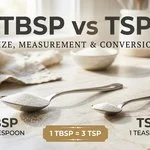
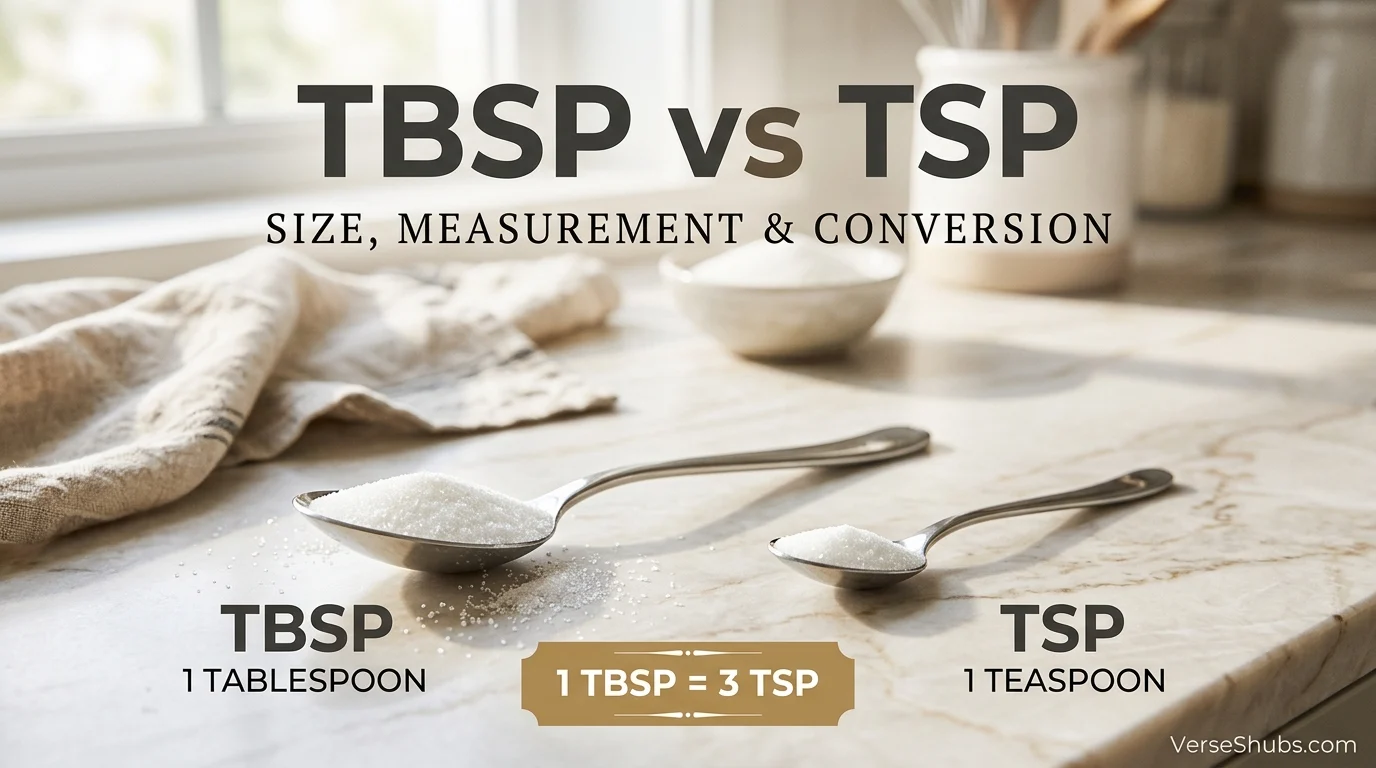
Tbsp stands for tablespoon, while tsp stands for teaspoon. In the US customary system, one tablespoon equals three teaspoons. This means a tablespoon holds three times as much as a teaspoon. Using the wrong spoon can affect the flavor, texture, and balance of a recipe, especially when measuring strong ingredients such as salt, baking powder, or vanilla extract.
Whether you are a beginner learning to cook, following an online recipe, or converting measurements for baking, knowing the difference between tbsp and tsp helps you measure ingredients accurately. Once you understand these abbreviations and their conversions, reading recipes becomes much easier.
Quick Answer: What Does tbsp vs tsp Mean?
Tbsp means tablespoon, and tsp means teaspoon. In US customary measurements, 1 tablespoon (tbsp) equals 3 teaspoons (tsp). A tablespoon measures approximately 15 milliliters, while a teaspoon measures approximately 5 milliliters. Always check the recipe’s measurement system because spoon sizes can vary slightly between countries.
Why Do People Confuse tbsp and tsp?
People often confuse tbsp and tsp because both abbreviations refer to measuring spoons and differ by only a few letters. In handwritten recipes or small text, the abbreviations can be easy to misread.
Here are the main reasons for the confusion:
- Similar abbreviations: Both contain the letters “sp,” which can make them look alike.
- Different capitalization: Recipes may use tbsp, Tbsp, tsp, or Tsp, depending on the writer’s style.
- Similar names: Tablespoon and teaspoon sound related, but their capacities are different.
- Recipe mistakes: Confusing the two measurements can change the amount of an ingredient significantly.
- Unfamiliar conversions: Some beginners do not know that one tablespoon equals three teaspoons.
The most important distinction is simple: a tablespoon is larger than a teaspoon.
What Does tbsp Mean?
Tbsp stands for tablespoon, a unit of volume commonly used in cooking and baking. It is useful for measuring ingredients in amounts larger than a typical teaspoon measurement.
In US customary measurements:
- 1 tablespoon = 3 teaspoons
- 1 tablespoon ≈ 15 milliliters
- 2 tablespoons ≈ 30 milliliters
- 4 tablespoons = ¼ US cup
When Is tbsp Used?
Tablespoons are commonly used for:
- Cooking oil and melted butter
- Salad dressings and sauces
- Honey and syrup
- Peanut butter
- Larger amounts of spices
- Liquid ingredients in baking
Example: If a recipe calls for 2 tbsp of olive oil, you need two tablespoons, equivalent to six teaspoons.
What Does tsp Mean?
Tsp stands for teaspoon, a smaller unit of volume used when a recipe requires a relatively small quantity of an ingredient.
In US customary measurements:
- 1 teaspoon ≈ 5 milliliters
- 3 teaspoons = 1 tablespoon
- ½ teaspoon ≈ 2.5 milliliters
- ¼ teaspoon ≈ 1.25 milliliters
When Is tsp Used?
Teaspoons are commonly used for:
- Salt and pepper
- Baking powder and baking soda
- Vanilla extract
- Ground cinnamon
- Small amounts of herbs and spices
- Flavoring extracts
Example: If a cake recipe calls for 1 tsp of vanilla extract, use one teaspoon rather than one tablespoon. Using a tablespoon would triple the intended amount.
tbsp vs tsp: Comparison Table
| Feature | tbsp (Tablespoon) | tsp (Teaspoon) |
| Full name | Tablespoon | Teaspoon |
| US customary volume | About 15 mL | About 5 mL |
| Conversion | 1 tbsp = 3 tsp | 1 tsp = ⅓ tbsp |
| Relative size | Larger | Smaller |
| Common uses | Oil, sauces, dressings | Spices, extracts, leavening agents |
| US tablespoons per cup | 16 | 48 |
| US teaspoons per cup | 48 teaspoons in 1 US cup | 48 teaspoons in 1 US cup |
Note: These conversions use standard US customary measurements. Metric tablespoon sizes differ in some countries.
When Should You Use tbsp or tsp?
Choose the measurement specified in your recipe. Do not substitute one for the other without converting the quantity.
Use tbsp When:
- The recipe calls for a tablespoon of oil.
- You need a larger quantity of sauce or dressing.
- You are measuring honey, syrup, or other ingredients in tablespoon amounts.
- You need to measure several teaspoons at once more conveniently.
Use tsp When:
- The recipe requires a small amount of salt or seasoning.
- You are measuring baking powder or baking soda.
- You need vanilla extract or another flavoring.
- You are following a recipe that specifies a teaspoon measurement.
Can You Substitute tbsp for tsp?
Yes, if you convert the measurement correctly. Because one tablespoon equals three teaspoons, you can replace 1 tbsp with 3 tsp or replace 3 tsp with 1 tbsp.
For example, if you do not have a tablespoon measure, you can use three teaspoons to measure one tablespoon of liquid.
12 Examples of tbsp vs tsp in Everyday Recipes
These examples show how the two measurements are used in practical situations.
- Olive oil: A salad dressing may require 2 tbsp of olive oil.
- Vanilla extract: A cake recipe may call for 1 tsp of vanilla extract.
- Salt: A soup recipe may require 1 tsp of salt.
- Honey: A marinade may use 1 tbsp of honey.
- Baking powder: A cake may require 2 tsp of baking powder.
- Lemon juice: A dressing may need 1 tbsp of lemon juice.
- Ground cinnamon: A cookie recipe may call for ½ tsp of cinnamon.
- Soy sauce: A stir-fry sauce may include 1 tbsp of soy sauce.
- Black pepper: A seasoning mixture may use ¼ tsp of black pepper.
- Sugar: A cup of tea may require 1 tsp of sugar.
- Melted butter: A recipe may need 2 tbsp of melted butter.
- Garlic powder: A spice blend may call for ½ tsp of garlic powder.
The quantities above are illustrative examples, not universal recipe requirements. Always follow the specific recipe you are using.
Common Mistakes When Using tbsp and tsp
Even experienced home cooks can make measurement errors. Understanding these common mistakes helps you avoid them.
- Reading tsp as tbsp: This can triple the intended quantity.
- Reading tbsp as tsp: This provides only one-third of the intended amount.
- Using ordinary eating spoons: Household spoons are not necessarily standardized measuring spoons.
- Ignoring the recipe’s measurement system: A tablespoon may not have the same volume in every country.
- Confusing volume with weight: One tablespoon of flour does not weigh the same as one tablespoon of honey.
- Measuring dry ingredients incorrectly: Packed brown sugar and loosely filled flour can produce different weights.
- Guessing small amounts: Baking often requires accurate measurements, particularly for leavening agents.
For reliable results, use proper measuring spoons and level off dry ingredients when the recipe calls for a level measure.
Memory Trick: How to Remember tbsp vs tsp
Here is an easy way to remember the difference:
- Tbsp = tablespoon = bigger.
- Tsp = teaspoon = smaller.
- Three teaspoons make one tablespoon.
Think of it this way: a tablespoon is the larger spoon, and a teaspoon is the smaller spoon.
Remember the number 3: every time you convert one US tablespoon into teaspoons, multiply by three. When converting teaspoons into tablespoons, divide by three.
tbsp vs tsp in American and British English
The abbreviations tbsp and tsp are widely understood in both American and British recipes. However, measurement conventions can differ.
In the United States, a standard tablespoon is approximately 14.79 mL and is commonly rounded to 15 mL. A standard US teaspoon is approximately 4.93 mL and is commonly rounded to 5 mL.
In the United Kingdom, a modern metric tablespoon is generally 15 mL, and a metric teaspoon is 5 mL. Older British recipes may use different measurement conventions.
Australia is another important exception: an Australian tablespoon is generally 20 mL, equivalent to four 5 mL teaspoons rather than three.
Practical tip: If you are following a recipe from another country, check its measurement conventions before converting ingredients, particularly when precision matters.
Similar Measurement Abbreviations You Should Know
Besides tbsp and tsp, recipes use several other abbreviations.
| Abbreviation | Meaning | Common US Measurement |
| tsp | Teaspoon | About 5 mL |
| tbsp | Tablespoon | About 15 mL |
| c | Cup | About 237 mL |
| oz | Ounce | Weight or fluid volume, depending on context |
| fl oz | Fluid ounce | About 29.57 mL |
| mL | Milliliter | Metric volume unit |
| L | Liter | 1,000 mL |
Be especially careful with oz and fl oz. An ounce is a unit of weight, while a fluid ounce measures volume. They are not interchangeable in every situation.
Final Verdict: Which Is Bigger, tbsp or tsp?
A tbsp (tablespoon) is bigger than a tsp (teaspoon). In standard US customary measurements, one tablespoon equals three teaspoons, making it easy to convert between the two.
Use tbsp for larger measured quantities and tsp for smaller ones, always following the recipe’s instructions. If you remember just one rule, remember that 1 tbsp = 3 tsp.
FAQs:
1. Is tbsp bigger than tsp?
Yes. A tablespoon (tbsp) is three times larger than a teaspoon (tsp) in US customary measurements. One tablespoon equals approximately 15 mL, while one teaspoon equals approximately 5 mL.
2. How many tsp are in 1 tbsp?
There are 3 teaspoons in 1 US tablespoon. For example, 2 tablespoons equal 6 teaspoons, and 4 tablespoons equal 12 teaspoons.
3. Is 1 tbsp the same as 15 mL?
Approximately, yes, for standard US and modern metric tablespoon measurements. However, an Australian tablespoon is generally 20 mL, so you should check the measurement system used by the recipe.
4. How many tablespoons are in 1 teaspoon?
One teaspoon equals one-third of a US tablespoon. To convert teaspoons into tablespoons, divide the number of teaspoons by three.
5. Can I use a regular spoon instead of a measuring spoon?
You can use an ordinary spoon in a pinch, but it may not hold the standardized amount. For accurate cooking and especially baking, use proper measuring spoons.
6. Does tbsp mean tablespoon or teaspoon?
Tbsp means tablespoon. Tsp means teaspoon. These abbreviations are commonly used in recipes to distinguish larger and smaller spoon measurements.
7. Is tbsp the same as a dessert spoon?
Not necessarily. A dessert spoon is a separate utensil, and its capacity can vary by country and design. Use a standardized tablespoon measure when a recipe specifies tbsp.
Remember This
- tbsp = tablespoon
- tsp = teaspoon
- 1 US tbsp = 3 tsp
- 1 tbsp ≈ 15 mL
- 1 tsp ≈ 5 mL
- Always check the recipe’s measurement system.
Conclusion:
Understanding tbsp vs tsp is a simple but important cooking skill. A tablespoon measures three times as much as a teaspoon in US customary measurements, and using the correct abbreviation helps you follow recipes accurately. Whether you are preparing a meal, baking a cake, or mixing a sauce, choosing the right measuring spoon makes the process easier.
The easiest rule to remember is that one tablespoon equals three teaspoons. Keep this conversion in mind, use standardized measuring spoons, and check international recipes for differences in measurement systems. With these basics, you can measure ingredients confidently and avoid common recipe mistakes.